
A leading healthcare directory operating in francophone MENA — connecting patients with doctors across specialties, conditions, and cities.
From 5,000 to 62,000 monthly clicks. No paid ads. No keyword luck.
The platform had a real product, real doctors, real patient demand — and a site that wasn't structured to rank for the queries patients actually search. The Visibility layer of the OAS framework rebuilt the content architecture into a system that captured high-intent medical searches at scale, compounding into 28× organic traffic growth over the engagement.
monthly · 12× growth
technical SEO + content architecture
regulated francophone market
100% organic acquisition
A platform with real demand. And a search engine that couldn't see it.
The starting point
The platform had been live for years. Hundreds of doctors listed, dozens of specialties, multiple cities covered, a clean booking flow. From the inside, it looked like a fully functional healthcare directory — and patients who arrived through word-of-mouth or paid traffic converted at healthy rates.
The problem wasn't the product. The problem was that almost no patient was finding it through Google. Around 5,000 monthly organic clicks — a fraction of what a directory of this scope should have been pulling in a market this size.
The brief was direct: "We have demand we can't see. Search isn't sending us the patients who should be finding us. Fix the SEO."
The real diagnosis
What looked like "an SEO problem" was actually three structural problems stacked on top of each other. The audit found them in the first week. Most of the engagement was about fixing them in the right order — not adding more content on top.
Before any tactic could work, the platform's content architecture had to be rebuilt to match how patients actually search for medical care. Which turns out to be very specific.
Three structural problems. Each one invisible until you look for it.
The audit took roughly a week. Most of the engagement that followed was about fixing these three issues in the right sequence — because they were stacked, and fixing them in the wrong order would have produced no compounding result.
The site wasn't structured to capture how patients actually search.
Patients don't search for "healthcare directory". They search for specific medical care, in a specific city, often for a specific condition. "Cardiologist in Casablanca." "Diabetes specialist near me." "Embolisation prostate Tunis." Three to five words. High intent. Geographically anchored.
The platform had hundreds of doctor profiles, but no systematic page architecture that mapped to those queries. There was no canonical landing page for "[specialty] in [city]". No condition-focused pages. Patient demand existed at scale — and the site had no surface area to capture it.
The doctor profiles weren't ranking. Neither were the content pages — because they didn't exist yet.
Existing doctor profiles were thin: a name, a specialty, a phone number, sometimes an address. To a search engine, these pages had nothing to evaluate against a patient's query. Worse, they all looked structurally identical — which meant Google treated them as low-differentiation duplicates and ranked almost none of them.
There were also no condition pages. No "what is X" educational content. No specialty deep-dives. The platform was selling expert medical access without any of the content that would convince Google — or a patient — that the experts behind it were worth trusting.
The technical foundation worked — barely. Not in a way that would compound.
Crawl budget was being burned on low-value pages. Internal linking pulled authority away from the pages that needed it. Schema was inconsistent or missing on most doctor profiles. Core Web Vitals were degraded enough on key landing pages to suppress mobile rankings. None of these were catastrophic individually. Stacked together, they were the ceiling.
The architecture problem and the content problem couldn't be solved until the technical foundation was repaired — because building 500 new pages on a site that couldn't index them properly would have produced exactly zero traffic. Sequence mattered.
The work, in order. Sequence is the strategy.
Six moves, executed over the engagement window. Each one was a prerequisite for the next. The compounding curve in the next section is what happens when this sequence runs end-to-end.
Technical repair: rebuilding crawl efficiency and indexability.
Fixed crawl budget allocation, restructured the internal linking graph, repaired schema across doctor profiles, addressed the Core Web Vitals issues blocking mobile rankings. No new content yet — the goal here was making sure the next 500 pages we built would actually index.
Keyword architecture: mapping patient intent at scale.
Built the full keyword universe at the intersection of specialty × city × condition. Hundreds of high-intent queries, each tied to a specific page template. This wasn't keyword research — it was content architecture, with the keyword data as the blueprint.
Specialty + city page system.
Designed and shipped a templated page system for "[specialty] in [city]" queries. Each page combined dynamic doctor listings with location-aware content, structured data, and internal linking that funneled authority into the high-conversion pages. This single page system became the largest single driver of the traffic curve.
Condition page production.
Wrote and shipped condition-focused content pages — what each condition is, treatment options, what to look for in a specialist, when to seek care. Calibrated for E-E-A-T compliance, which matters more in YMYL medical content than in any other vertical. Each condition page linked into the relevant specialty + city pages, creating a topical authority cluster.
Doctor profile differentiation.
Rebuilt the doctor profile template to give Google real signal — specialty depth, location context, practice details, structured data that mapped to medical entity schemas. Stopped Google from treating profiles as duplicates. Profile pages started ranking individually for branded doctor searches.
Internal linking flywheel.
Engineered the linking graph so that authority flowed predictably between condition pages → specialty pages → city pages → doctor profiles. Every new page strengthened the rest. This is the layer that turns SEO from a campaign into a system. Once it's running, growth compounds without proportional content investment.
5,000 → 62,000 monthly clicks. In Google's own data.
The shape of the curve matters more than the final number. The slow flat early weeks are the technical and architectural work — no traffic, no glamour, just the prerequisites. Then the inflection: once the page system started indexing, traffic compounded faster than I expected. By the end of the engagement window, organic clicks had multiplied 28×.
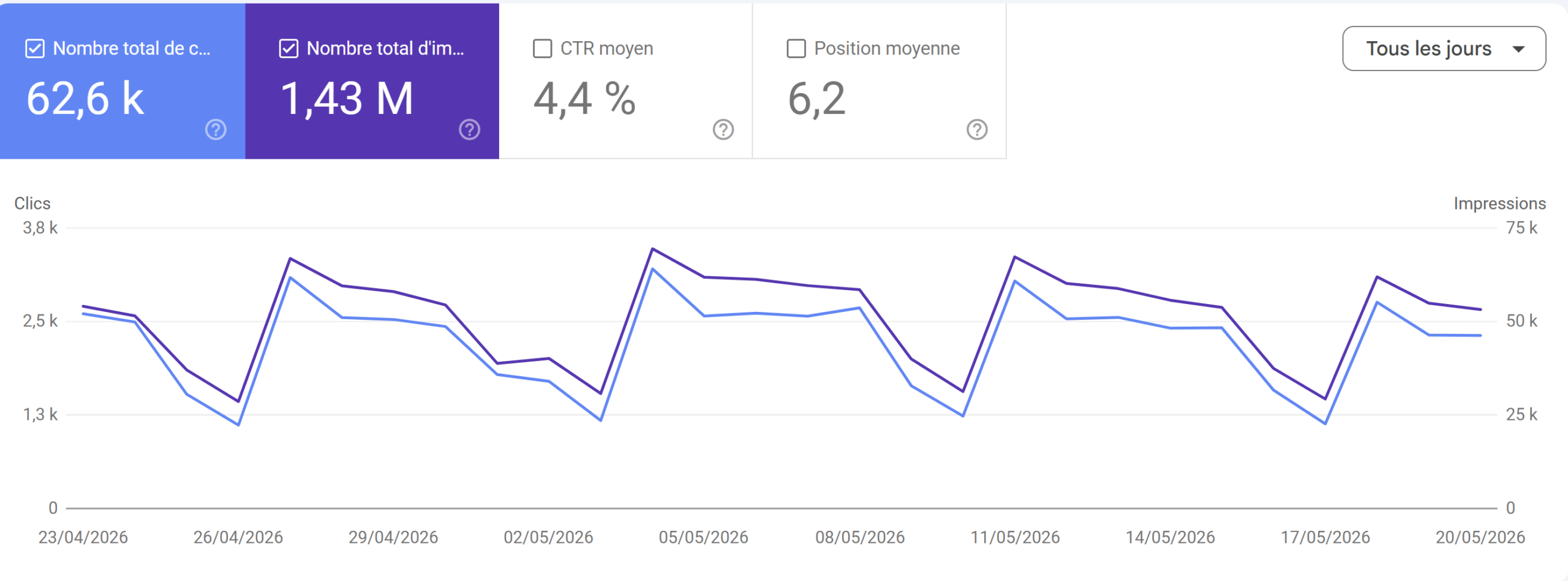
Source: Google Search Console · Engagement window · Organic clicks, monthly